
Dental implants
Using dental implants is now common practice in every dentist’s office. It offers an aesthetic and functional solution in case of one or more missing teeth, or complete tooth loss with fixed or removable prostheses.
Mon-Fri:
08:00-18:00
Sat-Sun:
closed
H-9200 Mosonmagyaróvár Április St. 1
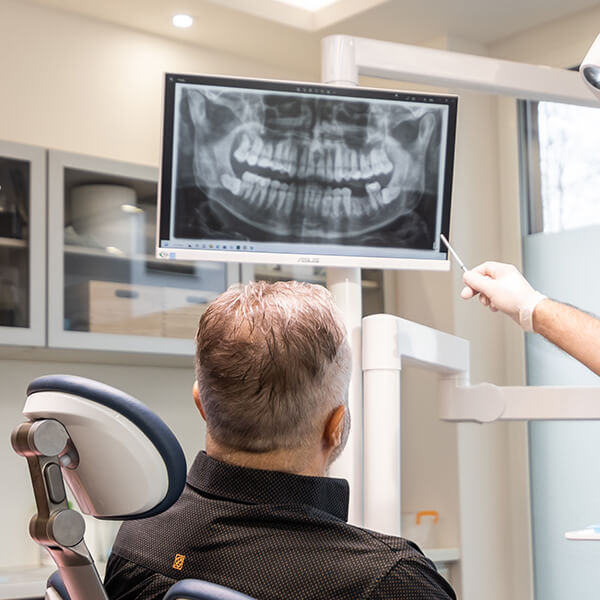
About implantation
Dental treatments in Hungary
The implant is an artificial tooth root made from titanium and surgically placed in the jawbone. The titanium doesn’t corrode, doesn’t irritate the surrounding tissue, is biocompatible. Depending on the number of missing teeth, crown or bridge is placed on the implant. The replacement tooth is your natural tooth’s perfect match both in appearance and function.
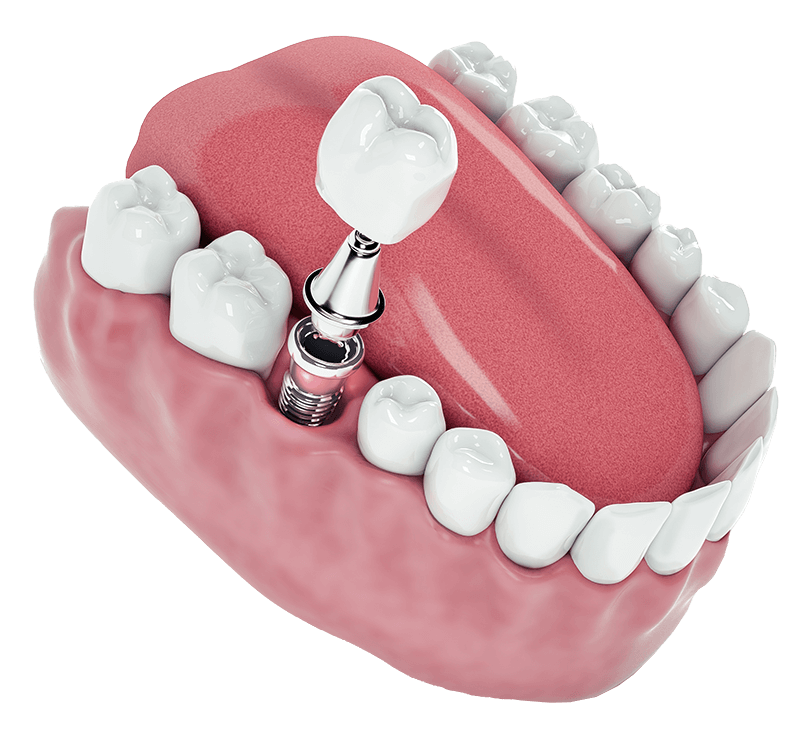
Implant-supported dental prosthetics
The implant is an artificial tooth root that is surgically placed in the jawbone.
Similarly to its natural counterpart, the implant is situated below the gum and does not protrude out from the bone, so it’s impossible to directly insert a crown or a bridge into it.The connecting link between implant and prosthesis (crown or bridge) is the abutment. It is the part that sticks out from the surface of the gum and the bone. The inside of the implant is hollow, the abutment is screwed into the hole after the healing period. It can be made from titanium or metal-free zirconium. The final part of the implant is the crown which can also be either zirconium- or metal-based depending on the material of the abutment: titanium abutments get crowns with metal frame, zirconium abutments get crowns with zirconium frame. Both get an aesthetic and natural-looking porcelain cover, giving the replacement teeth their final shape and colour. In the so-called smile-zone, we suggest using zirconium abutments due to aesthetic reasons, while in the chewing zone, we offer titanium.
The replacement of three missing teeth in a row can be done with three implants (and on them crowns) or with two implants and a bridge on them.
In the case of complete tooth loss, we suggest placing in a zirconium or titanium bridge fixed on 6 or 8 implants, or we can offer the so-called All on 4 method which require only 4 implants per jaw.

Immediate implant placement
We can insert implants immediately after dental tooth extraction, especially in the smile-zone. In this case, the tissue surrounding the teeth does not regress, so its ideal condition can be preserved.
IMMEDIATE TEMPORARY IMPLANT: an immediate dental implant can be used in case of sudden or broad tooth loss, particularly in the esthetic zone of smile. It’s usually placed at the same visit as the dental extraction, but it can be done within 1 or 2 days and still be considered an immediate dental implant.
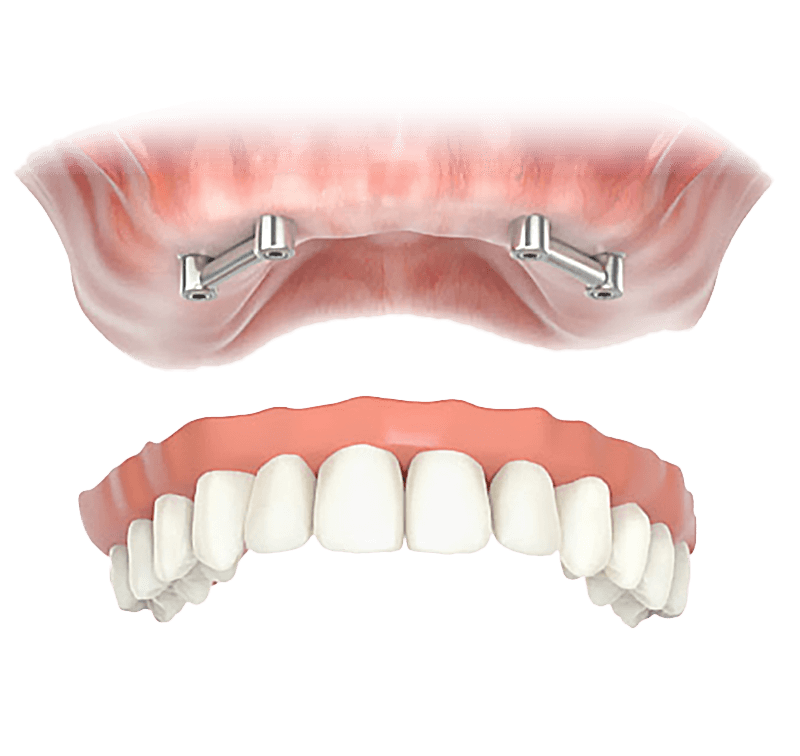
Partially removable tooth replacement
A partially removable tooth replacement offers a viable alternative to handle complete tooth loss.
It contains both fixed and moving parts. The bearing, provided by 4 implants, bounds together with titanium poles and rails. These act as fasteners, and together with the small precision mechanics fixation that positioned below the denture, they create a stable and easy to use unit. Due to the implantation, this partially removable tooth replacement has a stable anchorage, it will not wobble or move during use, providing a perfect sense of security. The moving part easily detached with a special motion. It should only be removed for cleaning.
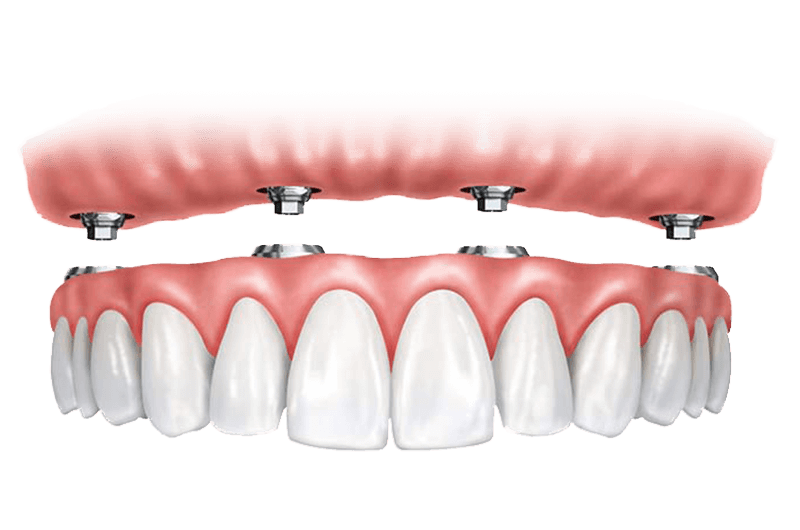
Fix-on-4
In this case, 4 implants in the lower and 4 in the upper jaw provide the necessary stability and complete fixation of the removable replacement teeth. The procedure is painless, carried out in local anesthesia. A couple weeks long healing period follows the operation while the patient gets a temporary removable replacement. After the healing period, a dental impression is made and within a couple of days, the dental technician’s laboratory prepares the final prosthesis.
Advantages
- only 4 implants are needed per jaw
- it provides stability during chewing and speaking
- natural looking
- similar to your natural teeth in loadability, there are no restrictions during use
- unlike the removable dental prosthetics, it doesn’t cause irritation or chafing; there is no need to use denture adhesives, or to take it out at night
About Dental Implants – Q&A
What are dental implants?
Do dental implants hurt?
How long does the surgery take?
Are dental implants right for me?
How long after the surgery can I eat solid food?
What can I expect after the anesthesia wears off?
What's the recovery time for dental implants? When will be the final replacement applied?
Can I go back to work right after the procedure?
How do I keep up the implant?
How long will the implants last? Will there be a need to replace?
Could a dental implant fail to "take"?
How much do dental implants cost?
Why is it necessary to replace missing teeth?
Related treatments

Bone grafting
Bone grafting is required before the placement of an implant, if you are edentulous for too long and the bone began to recess, the jawbone began to grow thinner and extenuate.
Different techniques and materials (your own bone from an other area of your body or artificial substitutes) can be used for the procedure, depending on the deficit of the bone. It’s an easily done and relatively painless dental surgery, performed under local anesthesia.
Sinus lift
The sinus lift is a type of bone grafting, its aim is to thicken the maxillary sinus.
Sometimes in the upper jaw, the loss of bone resulting from tooth loss is more significant. In this case, the insertion of an implant in the room of the upper-posterior molar teeth requires a sinus lift of the upper jaw’s bone. The loss of bone can be a result of anatomical characteristics (broad maxillary sinus, teeth with roots that reach into it) besides of tooth loss.
Dental surgery
Dental surgery can be understood as any number of medical procedures that involve surgery to manage dental or orthodontic problems or problems regarding the oral cavity.
For example, the removal of broken teeth, roots or wisdom teeth, cysts, root resection, bone grafting, sinus lift, implantation, etc.
Removal of wisdom teeth, complicated teeth removal
In general, the removal of a tooth is a fairly simple procedure; the tooth can be taken by the crown and removed with forceps. But when a tooth is situated in the bone or under the gum, or the crown is missing (because of an incident or dental decay), it can only be removed with dental surgery. The wisdom teeth often require surgical removal.
Only in the most ideal situations have the wisdom teeth enough room in the jaw to grow, they are often not able to erupt or can just partially erupt. The eruption can be blocked as a result of tooth displacement in the jaw (especially in the lower jaw) or lack of space. The process can cause pain and gingival inflammation, create cysts or crowding in the dental arch and can be the focus of a number of other medical issues.